
History of Referendums
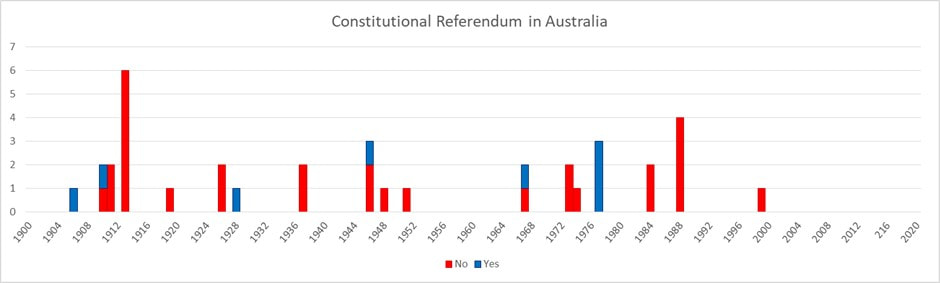
In total:
This is not a history of stasis but rather a history of change, of engagement and refinement. Some of these changes have been largely technical in nature, while others have been profoundly symbolic.
- There have been 44 referendums held in the 122 years since federation, the first in 1906, the last in 1999;
- Of these eight (8) have been successful (around 1 in 5 successful)
- But another 5 were supported by more than 50% of the electorate (so 1 in 3 favourable to electorate)
- Another 9 unsuccessful proposals received over 49% support (so 1 in 2 received over 49% support)
This is not a history of stasis but rather a history of change, of engagement and refinement. Some of these changes have been largely technical in nature, while others have been profoundly symbolic.
1967 – Aboriginal Rights
The most famous of these changes was the 1967 on Aboriginal Rights. This made two changes:
The referendum was a stunning success, with over 90% of the electorate voting in favour of the change.
This was an important example of a symbolic class of change - the 1967 referendum has taken on totemic character of the moment when Australia as a community formally recognised indigenous Australians as formally equal consistent members of the Australian community. For an overview of this impact of the 1967 Referendum, see the link below:
- It removed an express restriction, so that Parliament could pass law for any race including Aboriginal; and
- It removed s127 so that Aboriginal people were directly counted in reckoning the number of people in the Cth
The referendum was a stunning success, with over 90% of the electorate voting in favour of the change.
This was an important example of a symbolic class of change - the 1967 referendum has taken on totemic character of the moment when Australia as a community formally recognised indigenous Australians as formally equal consistent members of the Australian community. For an overview of this impact of the 1967 Referendum, see the link below:
For an accessible overview of how referendum work, with a focus on the 1967 referendum, have a look at this Expert Explainer:
1977 Referendum
In contrast, the most recent successful referendums were three changes proposed in 1977 to fix up some technical issues in the operation of government institutions:
Each of these passed with over 70% of the vote. While all three changes appear - to modern eyes - eminently sensible,
now.
- The first, to ensure that a casual vacancy in the Senate is filled by a person of the same political party;
- The second, to allow electors in Territories, as well as in the States, to vote in constitutional referendums;
- The third, to provide mandatory retirement ages for federal judges.
Each of these passed with over 70% of the vote. While all three changes appear - to modern eyes - eminently sensible,
now.
Implications
It is now over forty years since we successfully amended the Constitution in 1977, and nearly 20 years since a referendum was even held, in 1999. Both of these are record periods of time for our Federation.
|
Going on historical averages, we should have had 8 referendums in the last 20 years, with at least one successful |
These delay perpetuates the myth that Constitutional change is effectively implausible. This view is ahistorical.
The mere fact that we have not held a successful referendum for nearly two generations, or a referendum at all for a generation, should not be taken as any reason not to attempt the long overdue process of maintaining our Constitution
- Our Constitution was never meant to be static, and historically has not been.
The mere fact that we have not held a successful referendum for nearly two generations, or a referendum at all for a generation, should not be taken as any reason not to attempt the long overdue process of maintaining our Constitution